
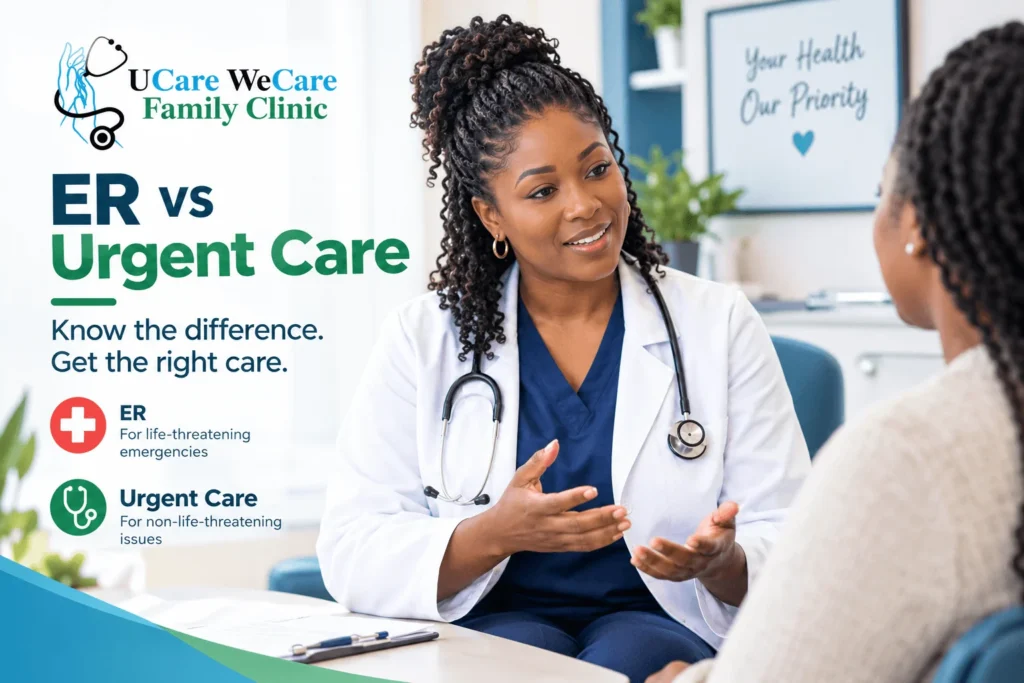
When you suddenly feel sick or get hurt, knowing where to go for medical care can be confusing. Should you visit an emergency room, or would urgent care be enough? Making the right choice can save time, reduce unnecessary costs, and help you get the care you need without delay.
For many non life threatening health concerns, urgent care offers a convenient option when your regular provider isn’t available. On the other hand, serious or potentially life threatening symptoms require immediate attention at an emergency room.
Understanding the difference between these two options makes it easier to act quickly when something unexpected happens.
What Is Urgent Care?
Urgent care centers provide medical attention for health problems that need prompt treatment but aren’t usually life-threatening. They can be especially helpful when you need care outside your regular appointment schedule.
For example, urgent care may be appropriate for a painful ear infection, a persistent sinus infection, a minor injury, or certain illnesses that can’t wait several days for a routine appointment.
Many people search for urgent care near me when they need medical attention quickly. Instead of waiting for a regular appointment, an urgent care clinic can provide timely evaluation and treatment for many common conditions.
Urgent care can also be useful when symptoms appear suddenly but don’t seem severe enough to require an emergency room.
When Should You Go to the ER?
An emergency room is designed for serious medical conditions that could threaten your life or cause permanent harm without immediate treatment.
Chest pain, severe difficulty breathing, signs of a stroke, major injuries, uncontrolled bleeding, severe allergic reactions, and sudden loss of consciousness are examples of situations that may require emergency care.
In these circumstances, don’t delay treatment while trying to find an urgent care clinic. If symptoms appear severe or life-threatening, call 911 or go to the nearest emergency room.
The key difference is urgency. Emergency rooms are equipped to handle critical conditions that require immediate testing, monitoring, and specialized treatment.
Urgent Care vs. ER: What’s the Difference?
Although both options provide medical care, they serve different purposes.
Urgent care generally focuses on conditions that require prompt attention but aren’t life-threatening. The ER handles emergencies that may require advanced medical equipment, specialists, surgery, or hospital admission.
Think about the severity of the problem first. If you’re dealing with a minor injury, infection, or sudden illness without dangerous symptoms, urgent care may be a practical choice.
However, if the condition could quickly become life-threatening, the emergency room is the safer option.
Common Problems Urgent Care Can Treat
Urgent care is often a good choice for everyday health problems that need faster attention.
Some common examples include:
- Ear infections
- Sinus infections
- Sore throats
- Colds and flu symptoms
- Minor cuts and burns
- Mild allergic reactions
- Sprains and strains
- Minor fractures
- Fever
- Certain stomach problems
- Urinary symptoms
- Minor skin infections
For instance, an ear infection can cause significant pain and discomfort. Although it may not be an emergency, waiting several days for a routine appointment may not be practical.
Likewise, sinus infections can cause facial pressure, congestion, headaches, and other uncomfortable symptoms. When symptoms become difficult to manage, prompt medical evaluation can help determine what’s causing them.
When Urgent Care May Be the Better Choice
Imagine waking up with a painful earache on a weekend. Your regular provider isn’t available, but you’re otherwise stable and don’t have serious symptoms.
In that situation, urgent care may make sense.
Similarly, suppose you’ve developed worsening sinus pressure, congestion, and facial discomfort. You don’t have severe breathing problems or other emergency symptoms, but you need medical attention soon.
Again, urgent care can be a reasonable option.
Choosing urgent care for appropriate conditions can also help keep emergency rooms available for patients experiencing true emergencies.
When the ER Is the Safer Option
Some symptoms shouldn’t be handled at urgent care.
Seek emergency medical attention for symptoms such as severe chest pain, serious breathing difficulty, uncontrolled bleeding, severe burns, major trauma, seizures, sudden confusion, or possible stroke symptoms.
A sudden change in speech, facial drooping, or weakness on one side of the body can be a warning sign of a stroke. These symptoms require immediate emergency evaluation.
Likewise, severe chest pressure accompanied by sweating, shortness of breath, nausea, or pain spreading to the arm or jaw should never be ignored.
When you’re unsure whether a symptom could be life-threatening, it’s better to seek emergency help rather than wait.
Finding Urgent Care in Newnan, GA
For residents looking for urgent care in Newnan, GA, convenience matters. Having a local option for non-emergency medical concerns can make it easier to get evaluated when your primary care appointment isn’t immediately available.
A nearby clinic may be helpful for common illnesses, minor injuries, infections, vaccinations, physical exams, and other routine healthcare needs.
Before choosing a clinic, consider its services, appointment availability, location, and the types of conditions it treats.
It also helps to keep your preferred healthcare provider’s contact information saved on your phone. That way, you won’t have to search from scratch when you’re feeling unwell.
Don’t Forget Preventive Care
Healthcare isn’t only about treating problems after they appear. Preventive care can help you stay healthier and identify potential concerns earlier.
Routine physical exams are one important part of preventive healthcare. Depending on your age, health history, and personal needs, a physical may include a review of your overall health, medications, lifestyle, and risk factors.
Regular visits can also provide an opportunity to discuss changes you’ve noticed in your health.
Additionally, adult vaccinations can help protect against certain preventable illnesses. Recommended vaccines can vary based on age, medical history, occupation, travel, and other factors.
Talking with a healthcare professional can help you understand which vaccinations may be appropriate for you.
What About Hormone Replacement?
Some healthcare concerns don’t fit neatly into the urgent care versus ER question. For example, hormone-related symptoms may require ongoing medical evaluation rather than emergency treatment.
Hormone replacement may be considered for certain patients experiencing symptoms related to hormonal changes. However, treatment isn’t one size fits all.
A healthcare professional can review your symptoms, medical history, medications, and individual health needs before discussing whether hormone-related treatment may be appropriate.
If you’re experiencing new or severe symptoms, don’t assume they’re simply caused by hormonal changes. Getting the right evaluation is important, especially when symptoms are unusual or suddenly become worse.
How to Decide Where to Go
When you’re sick or injured, ask yourself a few simple questions.
First, could this condition be life threatening? If yes, seek emergency care immediately.
Next, does the problem need attention soon but appear stable? If so, urgent care may be appropriate.
Finally, can the issue safely wait for a scheduled appointment? If the symptoms are mild and manageable, your regular healthcare provider may be the best option.
This simple approach can help you avoid unnecessary delays.
It’s also important to trust your instincts. If something feels seriously wrong, don’t ignore that feeling. Medical professionals can evaluate the situation and help determine the appropriate level of care.
Make a Plan Before You Need One
Healthcare decisions can feel much harder when you’re sick, tired, or worried. That’s why it helps to make a plan ahead of time.
Keep a list of important medications, allergies, existing health conditions, and emergency contacts. Know where your nearest emergency room is, and identify a convenient urgent care option for non-emergency problems.
Parents can also teach older children and teenagers the basic difference between urgent care and emergency care. Having this knowledge can make stressful situations a little easier to manage.
Most importantly, don’t wait for a serious situation to learn where to go.
Get the Right Care at the Right Time
Choosing between urgent care and the ER doesn’t have to be complicated. The main question is the seriousness of the condition.
For non-life-threatening problems such as ear infections, sinus infections, minor injuries, and certain sudden illnesses, urgent care may provide convenient and timely medical attention.
For severe or potentially life-threatening symptoms, the emergency room is the right choice.
Meanwhile, routine services such as physical exams, adult vaccinations, and ongoing healthcare visits can help support your health before problems become urgent.
If you’re searching for urgent care near me or looking for urgent care in Newnan, GA, take a moment to understand what services are available and when to seek emergency help. Knowing your options ahead of time can make the right decision much easier when you need care quickly.
FAQs
Q1. When should I choose urgent care instead of the ER?
Urgent care may be appropriate for non-life-threatening problems that need prompt attention, such as minor injuries, ear infections, sinus infections, and certain illnesses.
Q2. What symptoms require an emergency room?
Severe chest pain, major breathing problems, uncontrolled bleeding, serious injuries, stroke symptoms, seizures, and loss of consciousness may require emergency care.
Q3. Can urgent care treat ear infections?
Yes. Many urgent care centers evaluate and treat common problems such as ear infections when the condition isn’t showing signs of a medical emergency.
Q4. Can I get adult vaccinations at a clinic?
Many healthcare clinics offer adult vaccinations. The recommended vaccines depend on factors such as age, health history, and individual needs.
Q5. Are physical exams important for adults?
Yes. Regular physical exams can help monitor overall health, identify potential concerns, and support preventive healthcare.